
Home › Field notes › What an offshore licence is worth in Canada
What an offshore licence is worth in Canada
6 August 2026Marisol Trejo
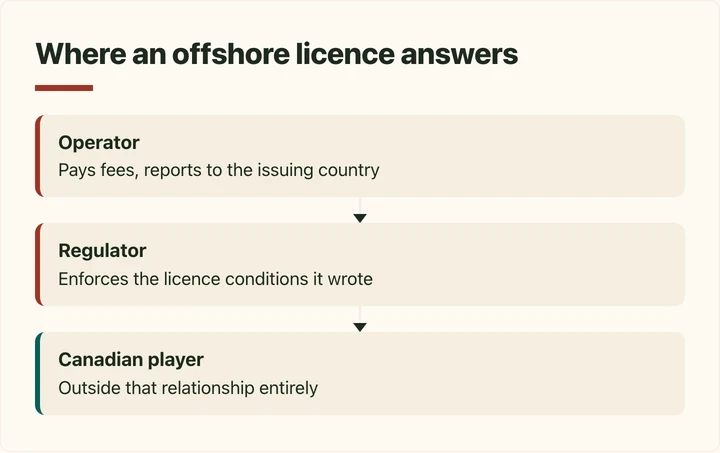
An offshore gambling licence is a real document, issued by a real authority. It licenses a company to operate in the eyes of the country that granted it. That is all it does. It does not register the company with any Canadian regulator. It does not put a Canadian dispute process behind the account. The gap matters more than the word “offshore” itself, and it is worth understanding before money moves.
This note walks through what an offshore licence actually covers, who issued it, and what changes for a player once a dispute needs somewhere to go. None of it is a verdict on any particular operator. It is the background a reader needs before deciding whether it is good enough for them.
What “offshore licence” means here
Two names come up most often when a footer names a licence at all. Curaçao and Malta are the two names. Both are real jurisdictions with real gambling law. Neither one is Canada, and neither one’s regulator has any authority in Ontario, British Columbia, Quebec or anywhere else a Canadian reader might be logging in from.
Malta’s regulator is the Malta Gaming Authority, an EU body that licenses online gambling operators under Maltese and European law. Curaçao’s regime is run by the jurisdiction’s own gaming authority, and its licensing structure has been moving away from an older system in which a small number of master licences sat above a crowd of sub-licensees. That transition is still in progress, so the exact shape of any particular Curaçao licence is worth confirming with the regulator directly. A footer badge alone will not settle it.
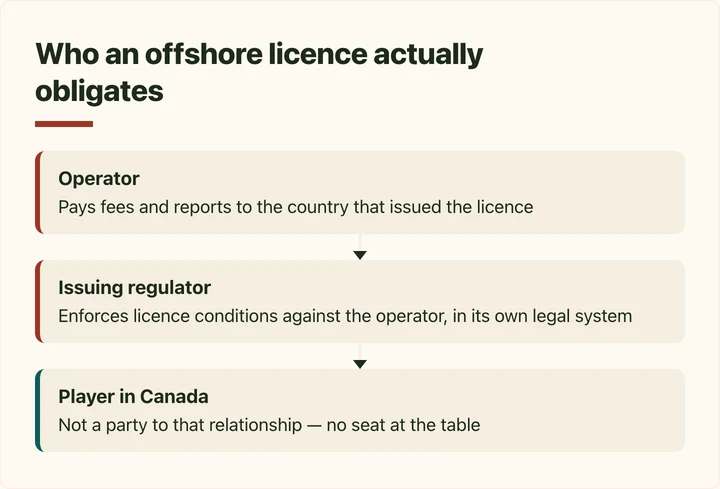
| Licence | Issued by | Answers to |
|---|---|---|
| AGCO registration + iGaming Ontario agreement | Alcohol and Gaming Commission of Ontario | Ontario’s regulator and government |
| Provincial lottery site (BCLC, Loto-Québec, ALC, and so on) | The province itself | That province’s own oversight |
| Offshore licence (Curaçao, Malta and similar) | The issuing country’s gaming authority | That country, not Canada |
Who it obligates, and to whom
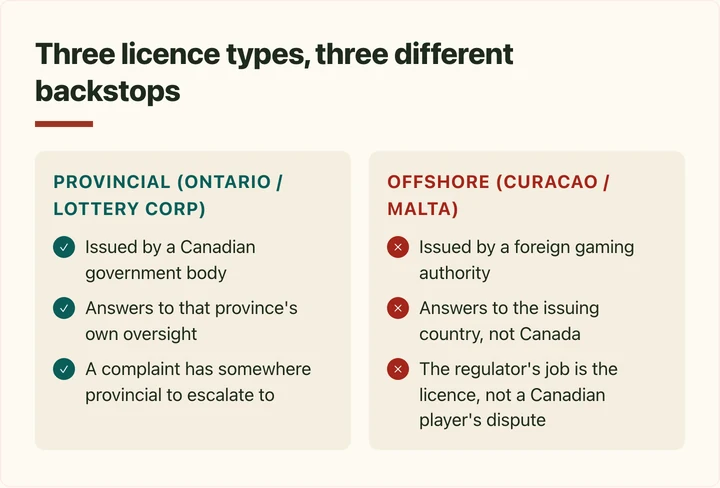
A licence is a relationship between two parties. One is the regulator; the other is the company it licenses. Reading the terms and paying the fees, an offshore operator answers to the country that issued its licence. Its reporting obligations, its audits, its renewal conditions and any penalties for breaking the rules all run in that direction, back to the regulator that granted the licence.
None of that relationship runs toward a player in Toronto or Calgary. A Canadian province is not a party to it and has no seat at that table. This is the part the two-minute check is built to surface early, well before money moves.
What a licence usually asks of an operator
Gambling licensing regimes share a few baseline conditions, wherever they sit.
- Player funds are kept apart from the operating company’s own money.
- The operator runs basic checks against money laundering.
- Players get some account-level controls, such as deposit or loss limits.
- Complaints have somewhere to land inside the business.
That much is common ground between a provincial regulator and an offshore one. What is not common ground is who checks that those conditions are actually met, how often, and what happens when they are not. A provincial regulator sits inside the same legal system as the player and can be escalated to by name. An offshore regulator sits inside its own legal system, checking compliance against its own law, for an operator that may serve players in dozens of countries the regulator has never had to think about individually. The baseline condition can be identical in wording and still mean something different in practice, because enforcement is a separate question from the rule on paper.
What breaks for a Canadian player, specifically
Here is the practical difference, laid out plainly. The mapping page names this as step four. It asks what breaks if something goes wrong. With an Ontario-registered operator, a player with an unresolved complaint has somewhere provincial to escalate it, because that operator answers to the Alcohol and Gaming Commission of Ontario and to its agreement with iGaming Ontario as a condition of doing business at all. With an offshore operator, the equivalent step does not exist. The issuing regulator’s job is to police the licence conditions the operator agreed to with that regulator. It is not there to arbitrate a withdrawal dispute for a player in another country who was never a party to the licence in the first place.
That does not mean an offshore-licensed site treats every player badly, or that every complaint goes nowhere. Reputable offshore operators run their own internal support and dispute processes, and some publish an external dispute-resolution contact as part of their licence conditions. It means the backstop is different. A provincial regulator can be escalated to as a matter of process. An offshore complaint process is whatever the operator built, reviewed by whoever the licence requires it to be reviewed by. None of that is a Canadian body with jurisdiction here.
Being licensed offshore is not, by itself, a red flag. Large, longstanding operators hold Malta and Curaçao licences and run clean businesses. The finding worth writing down is which recourse exists. That is different from a verdict on the company’s honesty.
The part that has nothing to do with gambling law
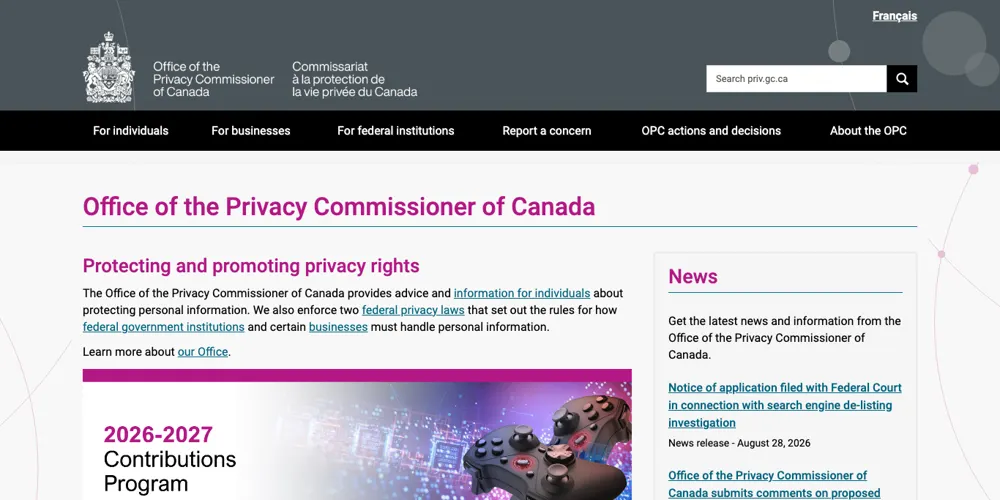
One obligation follows a company into Canada regardless of where it is licensed to gamble. It is how the company handles a Canadian customer’s personal information. Any organisation collecting personal data from people in Canada in the course of commercial activity falls within the mandate of the Office of the Privacy Commissioner of Canada, whether or not it holds any Canadian gambling registration. A gambling licence and a privacy obligation are two separate things, issued by two separate authorities, and an operator can be square with one while a reader still has no idea how it handles the other. It is worth reading a privacy policy on its own terms, separate from whatever the licence badge claims to cover.
Reading a licence claim without the badge doing the work
A footer graphic proves nothing on its own. A logo is an image file. It is not a record. The check that actually tells a reader something is looking the company name up in the register the badge claims to come from. The match has to be the exact entity named, checked against the brand on the front page, because the two are sometimes different. Ontario’s open market note walks through what that register-and-agreement pairing gives a player when the operator is registered there. Where a footer claims an offshore licence, the same instinct applies. Search the regulator’s own public register. Note whether the entity named matches, and note the date checked. If the register does not turn the entity up, or the site’s terms name a different company entirely, that mismatch is the finding. It says more about the operator than the badge does.
Age matters here too, though the two are unrelated in law. A licence, wherever it is from, does not verify a player’s age on its own; that check happens at the account level, and every legitimate operator, regulated or offshore, runs it before paying anything out.
What to do next
- Read the operator’s footer for the exact company name behind the brand.
- Search that company name in the licensing register the site claims to hold, and note whether it matches.
- Read the operator’s own dispute or complaints page before depositing, so the recourse is known in advance.
- Read the privacy policy separately from the licence badge; they answer to different authorities.
- Run the two-minute check on any new site before money changes hands.
None of this replaces the basics on the responsible gambling page: the legal age is 19 in most provinces and 18 in Alberta, Manitoba and Quebec, and free help is available whether the site in question is regulated in Ontario or licensed somewhere else entirely.
Writer and researcher, Raices Verdes