
Home › Field notes › Provincial or offshore: a two-minute check
Provincial or offshore: a two-minute check
6 August 2026Marisol Trejo
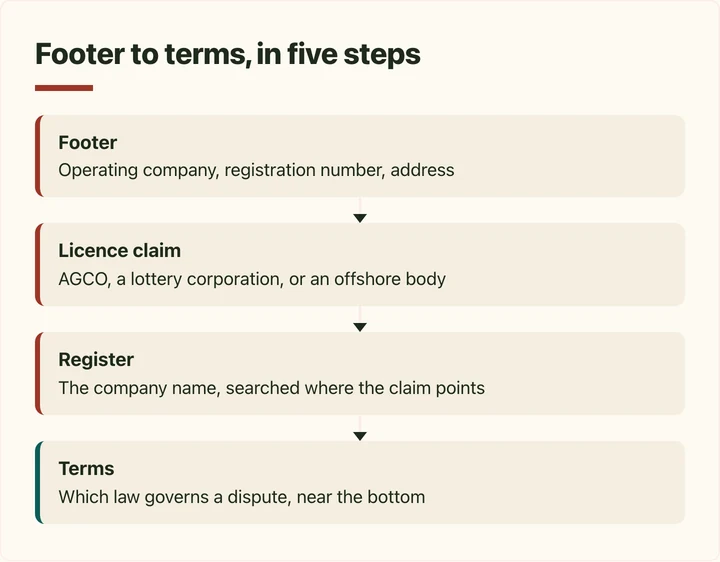
Two minutes and three browser tabs are enough to place most casino sites reaching Canada: provincial, or offshore. The check below is the fast version of the four-step method this site runs on every page, built to run on a phone before a deposit.
The checklist
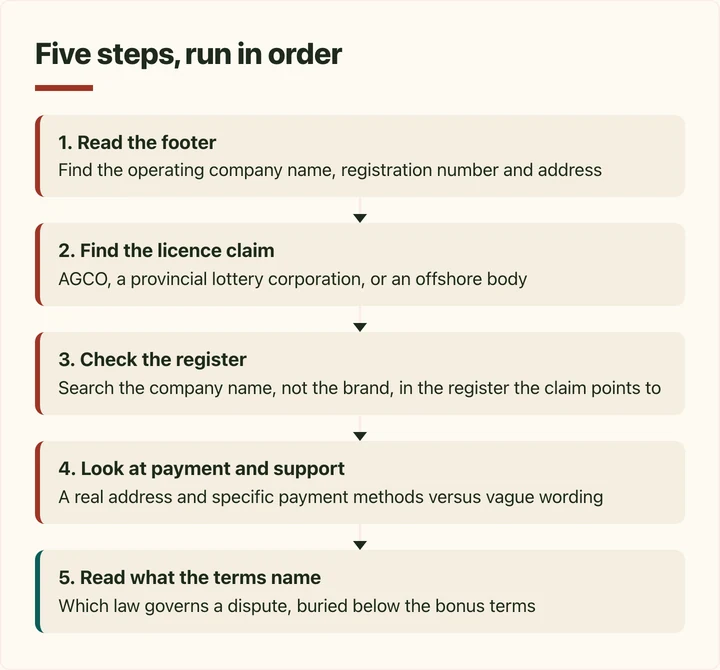
Open the site being checked and work through these five in order. Each step takes seconds, and skipping one is usually where the placement goes wrong.
- Read the footer. Scroll to the very bottom and look for an operating company name, a registration number, and a registered address. A brand name in the header tells you nothing; the footer is where the actual legal entity has to appear. If there’s nothing down there but social icons and a payment-logo row, that absence is the finding, and the rest of the checklist won’t fix it.
- Find the licence claim. Somewhere near that footer, or on a dedicated “About” or “Licence” page, the site should say who it answers to: the AGCO, a provincial lottery corporation, or an offshore body such as Curacao or Malta. Some sites state this plainly in a sentence; others bury it in a footer badge that links nowhere. A badge that isn’t a clickable link to the register is worth noticing on its own.
- Check the register. Take the company name from step one, not the brand name, and search it in the register the claim points to. AGCO publishes its list of registered operators, and iGaming Ontario lists the operating agreements that go with it. A provincial lottery site is simpler to confirm: it’s either the corporation’s own domain or it isn’t, and there’s no separate register to search.
- Look at payment and support. A support page naming a real address, and a payment page listing actual methods, usually belongs to a site that expects to be checked. Vague “secure gateway” wording with no specifics is a weaker sign, and so is a vague or missing page. A support email at a free webmail address, instead of the operating company’s own domain, turns up more often than the marketing suggests it should.
- Read what the terms name. The terms of service usually say, somewhere in the small print, which law governs a dispute. That’s rarely Ontario law for an offshore operator, and it tells you where a complaint would actually have to be filed. This clause is frequently the plainest sentence in the whole document, tucked well below the parts about bonuses and account closure that most people actually read.
What the checks tend to turn up
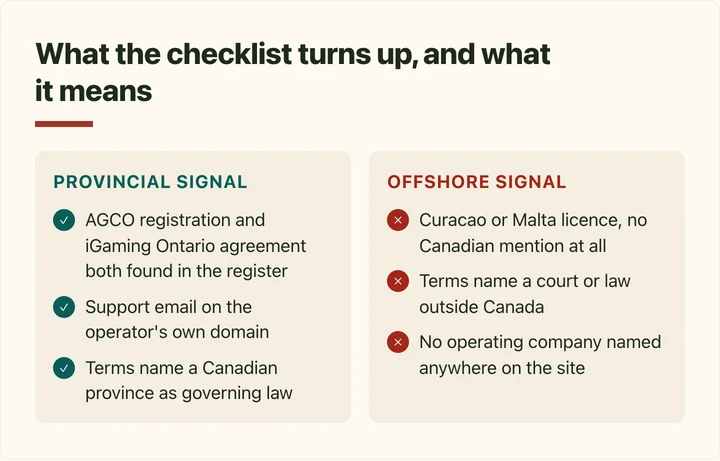
The five steps sort into a small number of patterns. The table below is what shows up in practice, and what each one means for a Canadian player.
| What you see | What it means |
|---|---|
| No operating company named anywhere | The one fact the whole check depends on is missing. Treat the site as unverifiable; that’s a different, harder problem than offshore. |
| A company named, no licence claim made | Common on provincial lottery sites, which don’t need to claim a licence. Also common on offshore sites that don’t bother. Move straight to step five and read the terms. |
| “Licensed and regulated” with no register named | An unverified claim. Find the register it’s supposedly in before taking it any further. |
| AGCO registration and an iGaming Ontario agreement, both found in the register | Regulated for Ontario players. See what that licence actually gives you before assuming it covers everything. |
| Curacao or Malta licence, no Canadian mention at all | What that licence is worth in Canada is a separate question from whether it’s real. |
| Terms name a court or law outside Canada | That’s where a dispute gets heard, whatever province the site otherwise talks about. |
A name match isn’t a check. Seeing the right words on a page, “AGCO,” “licensed,” “Ontario,” proves nothing by itself. The register is the only place a claim gets tested; everything before that step is marketing copy until someone looks it up.
Running it once, start to finish
Picture a footer with a company name and a registered address, and a licence line reading “regulated in Malta.” That covers steps one and two in under thirty seconds. Searching that company name in the AGCO register turns up nothing, because it isn’t supposed to be there. It’s an offshore licence, and the point of step three here is to confirm the claim isn’t dressed up as something bigger than it is. The support page lists an email on the operating company’s own domain, a small point in its favour. The terms name Maltese law as governing any dispute.
Five steps, one clean placement: a real company, an offshore licence, no provincial recourse for a Canadian player if a withdrawal goes wrong. That’s a complete, honest result, and it took the two minutes it was supposed to take. It’s a placement, not a verdict. Nothing in those five steps says whether the company treats players well, only where it’s rooted and who would have to hear a complaint.
Why the order matters
Running these five steps out of order usually produces the wrong answer. Reading the terms before finding the company name means checking a jurisdiction against nothing, because the terms haven’t been tied to anyone yet. Checking the register before reading the footer means guessing at a company name and searching for the wrong one.
The order matters for a second reason. It puts the hardest fact first. A missing footer ends the check in ten seconds and saves the other four steps entirely, and a footer with a full company name and address is already most of the way to an answer.
Support and payment pages come fourth on purpose, as supporting evidence for whatever the register already showed. Reading them before the register just means carrying an unconfirmed licence claim around longer than it needs to be carried.
Where this shortcut runs out
Two minutes tells you where an operator is rooted. It doesn’t tell you whether a register entry is current, whether an offshore licence is legitimate on its own terms, or whether a regulated operator is actually a good choice once the rooting question is settled.
Alberta is the clearest live example. The province has legislated to open a licensed private market, so the checklist above will place fewer operators cleanly there than it does in Ontario, simply because the register itself is still filling in. A blank result on an Alberta search isn’t proof of anything, offshore or otherwise. It usually just means the check needs repeating closer to the date the market actually opens.
A second limit sits inside the terms themselves. Some sites don’t say which Canadian provinces they accept players from at all, leaving that to a geo-block a reader never sees on the page. The checklist can only report what’s written down. Whatever gets enforced silently behind the page stays invisible to it.
Regulation isn’t a character reference either. A provincially registered operator can still handle a dispute badly, and an offshore one can still pay out reliably for years. The checklist establishes where recourse would come from if something goes wrong. It doesn’t establish whether anything will.
What to do next
- Open the footer of a site already in use and check whether the company behind the brand is recognisable.
- Take that company name to AGCO or the provincial lottery corporation covering the relevant province, and search it directly. A badge alone confirms nothing.
- Read the whole terms page for the governing law; it usually sits well below the licensing line near the top.
- Bookmark the register page once, so the next check takes less than two minutes as well.
- If a claim doesn’t match what the register shows, send us the site and what turned up; that mismatch is exactly what this site checks for.
None of this replaces reading a site’s terms in full, and none of it is for anyone under the legal age: 19 in most provinces, 18 in Alberta, Manitoba and Quebec. If running checks like this one stops feeling optional, responsible gambling has free help with no connection to any operator.
Writer and researcher, Raices Verdes