
Home › Field notes › Ontario’s licensed market, and what it actually gives you
Ontario’s licensed market, and what it actually gives you
6 August 2026Marisol Trejo
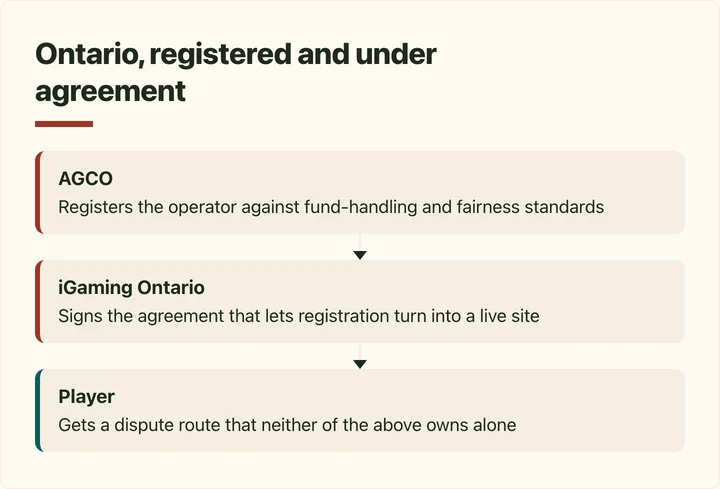
Ontario is the only province in Canada that has opened its online gambling market to private operators. An operator that wants to take Ontario players legally needs two things: registration with the Alcohol and Gaming Commission of Ontario (AGCO), and an operating agreement with iGaming Ontario, the body that runs the regulated market day to day. Neither piece alone is enough. Both change what happens if something goes wrong, and neither changes as much as a marketing page implies.
Every other province in Canada does this differently, which is the reason a single word like “licensed” tells you almost nothing on its own. Most provinces run their online offer through their own lottery corporation — BCLC in British Columbia, Loto-Québec in Quebec, the Atlantic Lottery Corporation across four Atlantic provinces — and treat everything outside that single site as outside their system entirely, licensed elsewhere or not. Alberta has legislated to open a private market of its own, closer to Ontario’s model, though which operators actually hold an Alberta registration is a question worth checking on the day rather than assuming from an Ontario one. Ontario got there first, and it is still the only province where a private company can be a fully regulated operator rather than an outside site tolerated by default.
Two pieces, one relationship
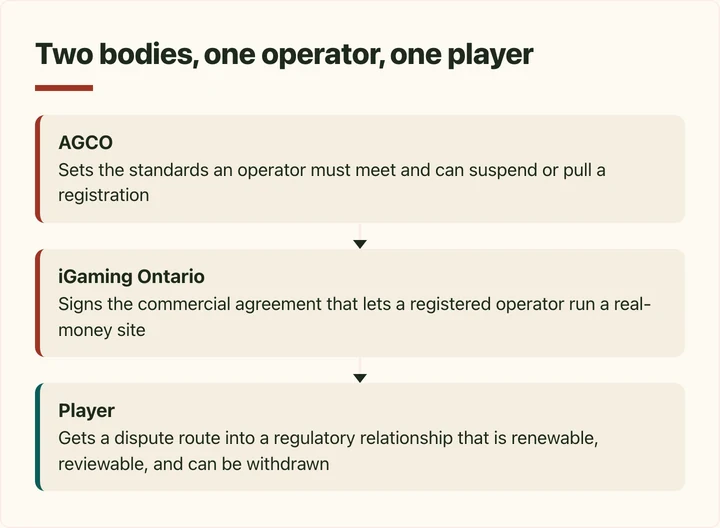
The AGCO is the regulator. It sets the standards an operator has to meet to hold a registration — things like fund handling, game fairness testing and complaint procedures — and it can suspend or pull that registration. iGaming Ontario is the AGCO’s operating partner: it signs the commercial agreement that actually lets a registered operator run a real-money site for Ontario players, and it maintains the list of who currently holds one.
Read together, they mean an operator selling to Ontario is inside a regulatory relationship with a real government body, not just claiming to be. That relationship is renewable, reviewable and can be withdrawn. An offshore licence, by contrast, is a one-way grant from a foreign company with no ongoing stake in how a Canadian player’s account is treated.
The two-body structure is not decoration. Splitting the regulator from the operating partner means no single office both writes the rules and signs the commercial deals, which is the kind of separation a single provincial lottery corporation, running its own site itself, does not have by design — it is the regulator, the operator and the only legal option, all at once. Neither structure is automatically the safer one for a player. They are simply different answers to who is watching whom, and that is exactly the question worth having an answer to before an account exists.
What actually changes for a player
Three things move when an operator is properly registered and under agreement.
A dispute route exists. A player with an unresolved complaint against a registered operator is not stuck arguing with the operator’s own support desk forever. There is a regulator behind the registration, and that regulator has a stated interest in how registered operators treat players. That is a structural difference from an offshore operator, where the only body with any authority over the company is the licensor itself, and the licensor’s interest is in the operator, not in the player.
Advertising sits under a standard, not a free hand. Registration comes with obligations around how a registered operator can market itself in Ontario — the specific rules are published by the AGCO and change over time, so we point at the source rather than restate a list here that could go stale.
Player protection tools stop being optional. Deposit limits, time or reality checks, cool-off periods and self-exclusion are the kind of account controls a registered operator is expected to offer, not a courtesy some sites include and others skip. Where they live in the account menu, and how easy each one is to find, is itself a useful check — a control that is one click away is a different product decision from one buried three menus deep in a help centre. What each of those tools actually does, deposit limit through to self-exclusion, is covered in full on our responsible gambling page, including the fact that self-exclusion in Canada runs province by province rather than through one national register — an Ontario self-exclusion covers Ontario’s registered market, not an offshore site reached from the same browser.
What it does not mean
Registration is not the same as a recommendation. It says an operator has met a set of standards to be allowed to operate — not that the operator is generous, fast to pay, or pleasant to deal with when a dispute actually happens. A registered operator can still be a poor choice for reasons that have nothing to do with licensing.
It also does not mean the registration follows the operator everywhere. An AGCO registration and an iGaming Ontario agreement cover Ontario. They say nothing about whether that same operator is legally reachable, or regulated at all, for a player sitting in British Columbia or Quebec.
A registration is not a guarantee. It changes who a player can complain to and
what standards apply going in — it does not promise a good outcome, and it does not travel with the
operator into a province where it holds no such agreement.
Contrast: one province, two structures
Not every province works this way, and the difference is worth seeing side by side.
| Question | Ontario, open market | Province with one provincial site |
|---|---|---|
| Who can legally offer online gambling | Any operator registered with the AGCO and under an iGaming Ontario agreement | Only the provincial lottery corporation’s own site |
| Where a complaint about a legal site goes | Toward a regulator with authority over a private operator | Toward the provincial corporation itself, as both operator and point of contact |
| Status of other operators reaching that province | Unregistered operators are outside the Ontario system even if they take Ontario players | Every other operator reaching that province is offshore, regardless of its home licence |
| What one licence number tells you | Which single operator, in that one province | Nothing — there is no private register to check |
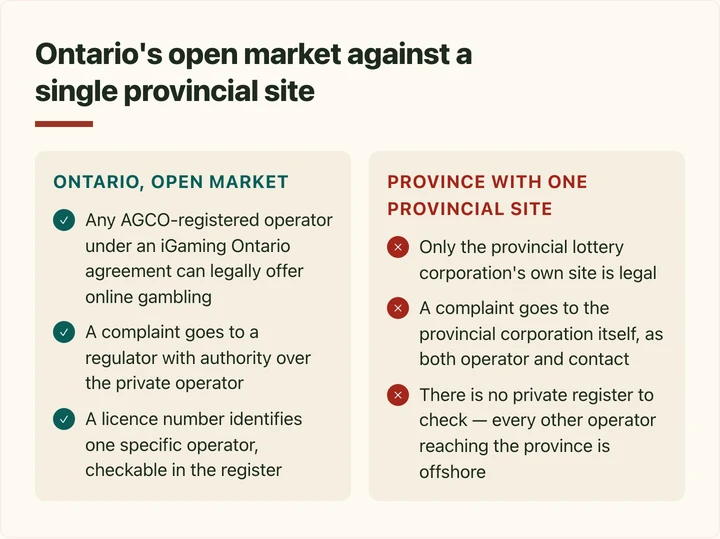
The pattern under both columns is the same. A licence, wherever it comes from, is only worth what the body issuing it is prepared to enforce, and only within the territory that body actually covers.
How to check it yourself
This is not something you have to take on trust. Our method is four repeatable steps — find the operating company, find the licence, check the register, and work out what breaks if something goes wrong — and it applies exactly the same way to a site claiming Ontario registration as to any other. The AGCO and iGaming Ontario both publish their own lists of who currently holds an agreement; a name that is not on either list, however confident the footer sounds, is not registered in Ontario.
What to do next
– Open the operator’s footer and note the exact company name, not just the brand — a brand can sit on top of more than one company over its life, and the footer is where that shows up first. – Check that name against iGaming Ontario’s list of registered operators, not against the operator’s own claim, and check the spelling matches exactly — a near-identical name is worth a second look, not a pass. – Find the account controls before you fund the account, not after. If deposit limits and self-exclusion are not visible without asking support, that is worth noting on its own. – If the site names a different regulator entirely, treat it as a different situation and read what an offshore licence is actually worth before deciding what that means. – If you are outside Ontario, do not assume an Ontario registration reaches you — check what covers your own province on the map, and see the two-minute check for a repeatable way to run all of this yourself on any operator’s site. – If anything about an account, a withdrawal or a limit feels wrong, use the dispute route the registration gives you rather than waiting it out or accepting the first answer support offers.
None of this replaces knowing your own limits. If gambling has stopped feeling like entertainment, our responsible gambling page has free, confidential help — the legal age is 19 in most of Canada, 18 in Alberta, Manitoba and Quebec, and this note is for readers above it.
Writer and researcher, Raices Verdes